Paediatric intravenous cannulation is far more than a routine component of the perioperative
checklist. It is a nuanced clinical skill that demands a careful integration of anatomical knowledge,
physiological understanding, and psychological sensitivity. This article, written from the perspective
of an anaesthesiologist with a particular interest in paediatric anaesthesia, examines the distinctive
features that make this seemingly simple task a complex and refined clinical practice.
Most clinicians will recognise the familiar scene. The operating theatre is prepared, the surgical
team is scrubbed, and the parents have just left after reassuring their child that they will return soon.
A favourite toy is clutched tightly in small hands as they wait anxiously outside the theatre doors.
Inside, we are faced with a wary two-year-old who regards the unfamiliar surroundings with a
mixture of curiosity and suspicion. The child’s hand is warm and plump, yet the only visible vein is
a tiny vessel that seems to retreat at the slightest touch. To an observer unfamiliar with this moment,
intravenous cannulation may appear to be a modest technical task. In adult practice, it is frequently
delegated to nurses or junior doctors. In paediatric patients, however, the same procedure demands a
level of expertise that develops only through experience and careful observation, and one that is
difficult to teach through formal instruction alone.
Fear of needles is an almost universal experience among young children. Negative procedural
experiences at this stage can contribute to persistent needle phobia later in life. The responsibility of
the anaesthesiologist therefore extends beyond the immediate procedural success of the day; it also
encompasses the child’s future relationship with healthcare. Each encounter in the operating room
can either reinforce fear or build trust.
Several non-pharmacological strategies have been shown to reduce perioperative anxiety in
children. Systematic reviews have demonstrated that distraction techniques—such as tablet-based
interactive games, bubble blowing, and virtual reality—can significantly reduce distress during
medical procedures. The role of parental presence during induction of anaesthesia has also been
widely discussed. Parental involvement can be beneficial when the caregiver remains calm,
understands their supportive role, and avoids interfering with the procedural team. Conversely,
parental anxiety may inadvertently heighten the child’s distress, as children often mirror the
emotional state of their caregivers. When parents are guided to use calm, reassuring language and
simple encouragement—phrases such as “You are doing very well, it’s almost finished”—their
presence can transform from a potential obstacle into a valuable source of support.
Pharmacological measures may also be used when anxiety or distress remains significant. In
selected situations, mild premedication with agents such as oral midazlolam can reduce procedural
stress. Intranasal dexmedetomidine is also used nowadays as an effective sedative with minimal
respiratory depression. When used judiciously and combined with appropriate non-pharmacological
preparation, these agents can help create a calmer atmosphere and improve the overall experience
for both the child and the clinical team.
A number of evidence-based strategies are available to improve first-pass success in paediatric
cannulation. The use of topical anaesthesia prior to intravenous access has become standard practice
in many elective procedures. The eutectic mixture of local anaesthetics (EMLA), consisting of
lidocaine and prilocaine, is widely used and must be applied under an occlusive dressing
approximately 60–90 minutes before the procedure. One limitation of EMLA is the vasoconstrictive
effect of prilocaine, which may reduce the diameter of superficial veins and occasionally make
cannulation more challenging. Amethocaine gel (4% tetracaine) offers an alternative option. It
produces effective analgesia within 30–40 minutes and is associated with local vasodilatation,
which may facilitate venous access.
In neonates and young infants, oral sucrose administered immediately before or during the
procedure has been shown to reduce behavioural pain responses. This effect is believed to occur
through activation of endogenous opioid and serotonergic pathways, providing a simple and
effective adjunct for procedural comfort.
Technological advances have also significantly improved vein visualisation. Near-infrared vein
visualisation devices, available since the early 2000s, allow clinicians to map superficial venous
structures with greater clarity. Transillumination techniques, which utilise a bright cold light source
to highlight superficial vessels, remain a practical and affordable option, particularly in neonates
and small children. In many institutions, a simple fibre-optic transilluminator continues to be an
effective bedside tool.
Over the past decade, ultrasound-guided vascular access has transformed the practice of paediatric
anaesthesia. Ultrasound allows direct visualisation of vascular structures and surrounding tissues,
thereby improving procedural accuracy. Multiple meta-analyses have demonstrated that ultrasoundguided techniques significantly improve first-attempt success rates when compared with traditional
landmark-based approaches.
Paediatric cannulation therefore represents more than a technical step during the perioperative
period. It reflects the broader scope of paediatric anaesthesia itself, where technical skill must
coexist with compassion, patience, and an awareness of the child’s emotional world. In the brief
moment when a small hand is extended, the clinician’s skill lies not only in finding the vein but also
in earning the child’s trust. Ultimately, it is this combination of attention, precision, compassion,
and respect for the child before us that defines what it means to be a paediatric anaesthesiologist. In
the right hands and with the right spirit, the simple act of placing a cannula becomes an expression
of genuine clinical art.
Dr Jiny Chandran
Senior Consultant, Baby Memorial Hospital,
Kozhikode
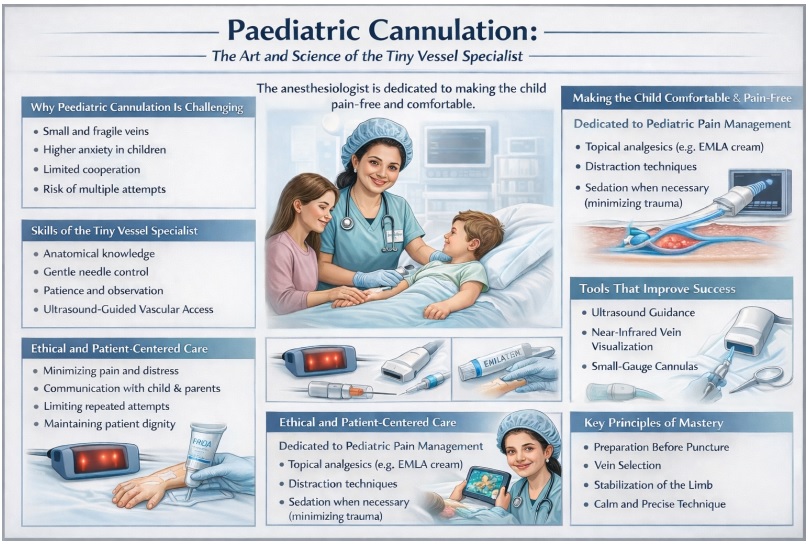
AI Disclosure: The infographics in this document were generated using ChatGPT. The text was authored by the user, with grammatical refinements provided by Gemini.